
(samanta-jvalāmālā viśuddhaisphūrita-cintāmaṇi-mudrā-hṛdayāparājitā mahāpratisāravidyā dhāraṇī)
Translator’s note:
The Mahāpratisarā Dhāraṇī (Chinese: 大隨求陀羅尼, Dà Suíqiú Tuóluóní), is a prominent Buddhist incantation associated with protection, the removal of obstacles, and the fulfillment of wishes. It belongs to the tradition of protective dhāraṇīs and is also included among the Pañcarakṣā, or Five Great Protectors, in Buddhist literature. Its Chinese name, particularly the expression suíqiú (隨求), emphasizes the idea of granting whatever one seeks or desires. However, despite this wish-fulfilling connotation, the actual content of the dhāraṇī is predominantly concerned with protection against dangers, misfortunes, malevolent beings, and other harmful influences. The Mahāpratisarā is exceptionally long, comparable in length to the famous Śūraṅgama Mantra as preserved in the Chinese Buddhist canon.
Historically, the practice of copying the dhāraṇī and wearing it as a protective amulet was remarkably widespread. Written and printed examples have been discovered at numerous archaeological sites across Asia, testifying to its popularity in both religious and everyday contexts. The surviving texts also exhibit considerable variation in their wording, arrangement, and transcription, suggesting that the dhāraṇī circulated through multiple textual traditions rather than a single fixed version. This remarkable textual diversity, together with the extensive archaeological evidence, reflects the wide geographical dissemination and enduring popularity of the Mahāpratisarā tradition.
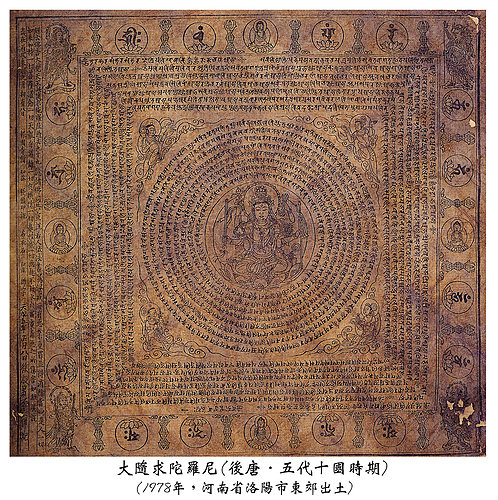
Excavated in the eastern suburbs of Luoyang, Henan Province, in 1978
Translated by Imperial Command by the Tripiṭaka Śramaṇa Amoghavajra of Da-xing-shan Monastery, Grand Commandant with Authority Equivalent to the Three Excellencies, Specially Advanced Acting Minister of Court Reception, Duke of the State of Su, Enfeoffed with Three Thousand households, Granted the Purple Robe, Posthumously honored as Minister of Works, Posthumous Title: Great Insight and Rectitude, Honorific name: Great and Vast Wisdom
Chapter One: Preface
Thus have I heard.
At one time, the Bhagavān was dwelling in the great pavilion on the summit of Vajra Sumeru, abiding in the Great Vajra Samādhi. The kalpa trees was adorned with great vajra. The jewel lotuses in the great vajra ponds shone with radiance, and the ground was strewn with vajra sand. It was a vajra maṇḍala sanctified by the great vajra empowerment, within the palace of Śakra, lord of the devas, resplendent with hundreds of thousands of koṭis and niyutas of great vajra lion thrones. It was endowed with the miraculous power of eloquence in teaching the Dharma, empowered by the spiritual power of all the Tathāgatas, a place of entry into the equality of all dharmas and of arising into Sarvajña knowledge.
He was accompanied by an assembly of eighty-four koṭis and niyutas of Bodhisattvas. They were all bound to only one more birth, had attained non-retrogression from Anuttarā-Samyak-Saṃbodhi, and had all attained great power. They all displayed the supernormal manifestations of Buddha lands through the Great Vajra Liberation Samādhi. In a single instant they could enter into the mental dispositions and conduct of all sentient beings. They had attained varied, wondrous, vast, and profound eloquence, skillfully taught all dharmas without obstruction, and possessed great supernormal powers. They were able to make vast oceans of cloud-like offerings to the Tathāgatas of immeasurable Buddha worlds. They had mastery of gates of liberation, Dhāraṇīs, samādhis, supernormal powers, unique qualities, factors of awakening, paths, stages, and Pāramitās; they were skilled in the four means of embracing beings; and through the power of loving-kindness, compassion, sympathetic joy, and equanimity, their streams of mind were secluded and purified. Their names were:
Vajra Treasury Bodhisattva-Mahāsattva, Vajra Eye Bodhisattva-Mahāsattva, Vajra Body Bodhisattva-Mahāsattva, Vajra Wisdom Bodhisattva-Mahāsattva, Vajra Hand Bodhisattva-Mahāsattva, Vajra Conjoin Bodhisattva-Mahāsattva, Vajra Nārāyaṇa Bodhisattva-Mahāsattva, Vajra Manifestation Bodhisattva-Mahāsattva, Vajra Heap Bodhisattva-Mahāsattva, Vajra Topknot Bodhisattva-Mahāsattva, Vajra Wonderous Bodhisattva-Mahāsattva, and Vajra Banner Bodhisattva-Mahāsattva.
He was accompanied by these and other foremost Bodhisattva-Mahāsattvas.
He was also accompanied by a great assembly of Śrāvakas, all of whom were great Arhats. They had severed the fetters of existence and exhausted all outflows, attained right knowledge and well-liberated minds, and were able to manifest inconceivable supernormal powers and sportive displays of miraculous transformation. They had all attained great power and were unobstructed in their knowledge and vision. Free from every defilement, they had burned away the seeds of habitual tendencies. Their names were the venerable Śāriputra, the venerable Pūrṇa Maitrāyaṇīputra, the venerable Kapphiṇa, the venerable Subhūti, the venerable Kāśyapa, the venerable Mahākāśyapa, and the venerable Uruvilvā Kāśyapa. He was accompanied by these and other foremost members of the great assembly of Śrāvakas.
There was also the deva Maheśvara as the foremost, accompanied by immeasurable, boundless, indescribable asaṃkhyeyas of devas of the Pure Abodes.
There was also Great Brahmā, lord of the Sahā world, as the foremost, accompanied by the assembly of Brahmā devas.
There were also the deva Suyāma, a deva of the Heaven of Joy Emanation, a deva of the Heaven of Mastery over Others’ Emanations, and Śakra, lord of the devas, each accompanied by a retinue of devas.
There were also Vemacitrin, King of the Asuras; Māli, King of the Asuras; Joyful Excitement, King of the Asuras; Shining, King of the Asuras; and Rāhu, King of the Asuras. With these foremost Asura kings were immeasurable and boundless Asura kings as their retinues.
There were also Sāgara, King of the Nāgas; Takṣaka, King of the Nāgas; Vāsuki, King of the Nāgas; Śaṅkhapāla, King of the Nāgas; Karkoṭaka, King of the Nāgas; Lotus, King of the Nāgas; and Great Lotus, King of the Nāgas. With these foremost Nāga kings was an immeasurable, boundless, asaṃkhyeya assembly of Nāga kings.
There was also Druma, King of the Kinnaras, accompanied by an immeasurable retinue of Kinnara kings.
There was also Achieved-All-Goals, King of the Vidyā-Holder Seers, accompanied by an immeasurable retinue of Kings of Vidyā-Holder Seers.
There was also Five-Topknot, King of the Gandharvas, accompanied by an immeasurable retinue of Gandharva kings.
There was also Gold-Silver, King of the Garuḍas, accompanied by an immeasurable retinue of Garuḍa kings.
There were also Vaiśravaṇa, King of the Yakṣas; Jewel Virtue, King of the Yakṣas; Filled Virtue, King of the Yakṣas; and Pāñcika, King of the Yakṣas, accompanied by immeasurable and boundless retinues of Yakṣa kings.
There was also the Mother Hārītī, accompanied by her five hundred sons. There were also the seven Mothers of the World, the seven great Rākṣasīs, the seven Ṛṣi devas who roam through space, the nine Graha devas, the deities of the cardinal and intermediate directions, the Earth Deity, and the goddess Sarasvatī, each accompanied by their respective retinues.
There were also the obstacle-making Vināyakas, together with pretas and bhūtas. All were beings of great majestic power, each accompanied by their respective retinues.
There were also all the kings of mountains, all the kings of the seas, Varuṇa the Water Deva and guardian of the world, Dhṛtarāṣṭra, Virūḍhaka, Virūpākṣa, Daṇḍapāṇi the lord of the Rākṣasas, the seven Wind Devas, and Īśāna together with his consort, accompanied by one thousand koṭis and niyutas of attendants.
There was also the deva Nārāyaṇa, accompanied by his retinue.
There were also Dattaka, Dāmaka, Lohaka, Mahāgaṇapati, and Megholka, and other kings of the Vināyakas, accompanied by immeasurable and boundless Vināyakas as their retinues.
There were also sixty kings who roamed among the cities and fortresses, accompanied by their retinues.
There were also the four sister goddesses together with their brother, accompanied by their retinue.
There was also Vajra Śaṅkarā, accompanied by sixty-four Vajra maidens as her retinue.
There were also the youth Vajra Army, the youth Subāhu, and the youth Summit-Walker, accompanied by an immeasurable retinue belonging to the Vajra family.
There were also devas, nāgas, yakṣas, gandharvas, asuras, garuḍas, kinnaras, mahoragas, bhūtas, piśācas, apasmāras, unmādas, sādhyas, sāhillikas, and ostārakas who had pure faith in the Buddha, the Dharma, and the Sangha; as well as the devas of the sun and moon, the deities of dawn, midday, dusk, and midnight, and the deities presiding over all times, together with immeasurable, boundless asaṃkhyeyas of attendants.
At that time, the World-Honored One had excellently turned the Dharma wheel and completed the work of a Buddha. His merit and wisdom were ultimately perfect and complete. He had perfectly embraced omniscience and Great Bodhi and had attained the Pāramitā stage in blazing splendor. His Dharma body was adorned with the thirty-two marks of a great man, and all the parts of his body were adorned with the eighty-four secondary characteristics. The crown of his head could not be seen by any sentient being. He transcended all Māras, fully comprehended Sarvajña knowledge, and possessed the five eyes. He was endowed with every excellent aspect, endowed with Sarvajña knowledge, and endowed with all Buddha Dharma. He crushed all Māras and proponents of rival doctrines. His fame and renown were exalted, and as a great and valiant hero he sounded the mighty lion’s roar, destroying the darkness of ignorance. Through the Pāramitās of Giving, Precepts, Patience, Diligence, Meditation, Prajñā, skillful means, vows, power, and wisdom, accumulated over immeasurable, boundless asaṃkhyeyas of hundreds of thousands of koṭis and niyutas of kalpas, and through difficult practices and austerities, he had attained the thirty-two marks of a great man and the adornment of the eighty-four secondary characteristics. He sat upon a great jeweled Vajra Lotus-Womb Lion Throne. The throne was adorned with innumerable nets of vajra jewels and pearls, which, stirred by gentle breezes, produced wondrous sounds. It was firmly established upon platforms and footrests of innumerable vajra jewels. It was adorned with innumerable vajra jewels and with makara mouths from which strings of red pearls issued and were held within their jaws. The stamens of its lotuses were adorned with innumerable jewels, with amber and great amber, sapphire and great sapphire, and Puṣparāga gems, while radiant nets of light adorned it throughout with exquisite beauty. The shafts of its canopies were adorned with innumerable vajra jewels, and it was beautified by the shade cast by immeasurable hundreds of thousands of koṭis and niyutas of kalpa trees. The throne was vast and expansive like Sumeru. Like a golden mountain, it blazed with auspicious splendor and was adorned with a radiance surpassing that of a thousand suns. The ground was full and perfect like a stainless moon, deeply pleasing for all sentient beings to behold. The Dharma of the Tathāgata was like a great kalpa tree with its flowers in full bloom. The wondrous Dharma he taught was good in the beginning, good in the middle, and good in the end; its meaning was profound and far-reaching, its expression skillful, and it was pure, immaculate, completely unsullied, and unmixed.
At that time, the World-Honored One emitted a great radiance from the ūrṇā hair-mark. This radiance was called the Radiance-Net Revealing All Tathāgatas. Through this radiance, the entire trichiliocosm was universally illuminated, extending as far as Buddha worlds as numerous as the sands of the Ganges. All the Tathāgatas in those worlds, teaching the Dharma in magnificently adorned pavilions upon lion thrones adorned with immeasurable jewels, together with all the Bodhisattvas and great Śrāvakas, bhikṣus, bhikṣuṇīs, virtuous men and women of pure faith, devas, nāgas, yakṣas, gandharvas, asuras, garuḍas, kinnaras, and mahoragas, were all illuminated and appeared distinctly. At that time, the World-Honored One proclaimed these gāthās for the entire assembly:
“I shall now proclaim Mahāpratisarā, out of compassion for all sentient beings.
This great Dhāraṇī can subdue those difficult to tame
And destroy the gravest evil offenses.
If one merely hears this Mahāpratisarā Dhāraṇī,
All offenses are extinguished. It brings happiness to sentient beings and liberates them from every illness.
Out of great compassion for sentient beings, the World-Honored One therefore proclaims it,
So that they may attain liberation and remain far removed from the evil destinies.
If one enters the palaces of the Asuras, or the abodes of Yakṣas, Rākṣasas,
Bhūtas, Nāgas, ghosts, and spirits, one may enter all such dwelling places at will,
For this Great Vidyā will provide protection.
In dangerous places of battle, one will not be harmed or defeated by enemies.
All possessing spirits and the like, through the invocation of this Dhāraṇī,
Will be utterly destroyed.
Skandas, Unmādas, Piśācas, and Ḍākinīs, fierce devourers of vital essence
who constantly harm sentient beings, will all be destroyed.
Through the majestic power of Mahāpratisarā, hostile forces will all be destroyed.
Severe harmful sorceries and rites of imprecation and cursing will have no effect.
Even fixed karma will not bring its result, and one will not be afflicted by poisonous sorcery.
From water and fire, blades and staffs, thunderbolts, lightning, frost and hail,
Black winds and violent storms, one will be freed from every danger,
And all enemies will be subdued.
If anyone upholds this Vidyā or wears it upon the neck or arm,
Whatever that person seeks will be accomplished.
Every wish and aspiration will be fulfilled according to desire.
The lords of the devas will all grant protection, as will the great Nāga kings,
Bodhisattvas of great vigor, Pratyekabuddhas and Śrāvakas,
All the Tathāgatas, and Vidyā goddesses of great supernormal power.
They will all embrace and protect the one who upholds Mahāpratisarā.
Vajrapāṇi, the Lord of Secrets, and the Four Great Heavenly Kings, guardians of the world,
Will constantly protect, by day and by night, the person who upholds and recites it.
Śakra together with the devas of Trāyastriṃśa, Brahmā, Viṣṇu, and Maheśvara,
Gaṇapati and Kumāra, Mahākāla and Nandikeśa,
All the hosts of Divine Mothers, other hosts belonging to Māra,
Ṛṣis of great majesty who practice austerities, and other mantra deities
Will all come to embrace and protect the one who upholds Mahāpratisarā.
Bodhisattvas of great majestic power, and greatly compassionate Vidyā goddesses,
Heroic and endowed with supernormal power, Māmakī and Bhṛkuṭī,
Tārā, Aṅkuśī, and Vajra-Lock,
The White One and Great White One, the noble Mahākālī,
The Messengers and Vajra-Messengers, the Wonderous-Rope One and Vajra-Rope One,
The Wheel-Holder and Great Force One, the Vajra-Rosary and Great Knowledge One,
The Ambrosia-Kuṇḍalī, the Invincible Vidyā goddess,
The Black-Eared Auspicious One,the Highly Fortunate One with Majestic Power
The Lotus-Kuṇḍalī, the Flower-Toothed and the Jewel-Topknot,
The Golden Hair One, Piṅgalā, the Auspicious One with Majestic Power,
And The Devi Garlanded with Lightning, the great Rākṣasī Single-Hair-knot,
The Protectress of the Buddha ground, the Vidyā goddess Kāpālinī,
The Majestic One of Laṅka, and many other classes of such beings:
They will all provide protection.
When this Great Vidyā is in one’s hand, Hārītī together with her children,The great general Pāñcika,
Śaṅkhinī and Kūṭadantinī, Śrīdevī and Sarasvatī,
Will constantly follow that person, by day and by night, because that person upholds this secret words.
If any woman upholds this Dhāraṇī, she will attain every accomplishment.
Whether the child within her womb is male or female, the fetus will grow safely,
And childbirth will be peaceful and easy.
All illnesses will be eliminated, and all offenses will be extinguished.
The power of merit will always be complete, And grain, wealth, and treasures Will continually increase.
Her words will be pleasing to hear, And wherever she goes she will be treated with respect.
Any man or woman Who purely receives and upholds it
Will constantly cherish a mind of loving-kindness and compassion,
Seeking to rescue all sentient beings, Wishing that they may all attain happiness
And be freed from illness.
Kings and those of their inner palaces will all give rise to minds of respect toward such a person.
Auspiciousness will continually blaze forth, and the accumulation of merit will increase.
All mantra rites will be completely accomplished. One will successfully enter all maṇḍalas and attain the samayas.
These are the truthful words of the Tathāgata.
Evil dreams will not assail one, and all offenses will be extinguished.
Afflictions and enemies, and calamities caused by the Stella-Seizers, will all disappear.
This was proclaimed by the One with Great Wisdom and is able to fulfill the wishes and desires of beings.
Therefore I now proclaim it. Let the entire assembly listen attentively.
namaḥ sarva tathāgatānāṃ | namo namaḥ sarva buddha bodhisattva buddha-dharma-saṃghebhyaḥ | oṃ vipula garbhe | vipula vimale jaya garbhe | vajra jvala garbhe | gati gahane gagana viśodhane | sarva pāpa viśodhane | oṃ guṇavati gagariṇi giri giri gamari gamari | gaha gaha gargāri gargāri gagari gagari gaṃbhari gaṃbhari gati gati gamane gare | guru guru gurune | cale acale mucale jaye vijaye | sarva bhaya vigate | garbha saṁbharaṇi | śiri śiri miri miri ghiri ghiri | samantā karṣaṇi sarva śatru pramathaṇi | rakṣa rakṣa mama sarva sattvānāṃ ca |
viri viri vigatā varaṇa bhaya nāśani | suri suri ciri kamale vimale | jaye jayāvahe jayavati | bhagavati ratna makuṭa mālā dhāriṇi | bahu vividha vicitra veṣa rūpa dhāriṇī | bhagavati mahā vidyā devi rakṣa rakṣa mama sarva sattvānāṃ ca | samanta sarvatra sarva pāpa viśodhane | huru huru nakṣatra mālā dhāriṇī rakṣa rakṣa mām | mama anāthasya trānan parāyaṇānsya | parimocaya me sarva duḥkhe bhyaḥ caṇḍi caṇḍi caṇḍini vega vati sarva duṣṭa nivāraṇi | śatrū pakṣa pramathani vijaya vāhini | huru huru muru muru curu curu āyuḥ pālani suravara mathani | sarva devatā pujite | dhiri dhiri samantā valokite | prabhe prabhe suprabha viśuddhe sarva pāpa viśodhane | dhara dhara dharaṇī dhara dhare | sumu sumu ru ru cale cālaya duṣṭāṃ | puraya me āśāṁ śrī vapur dhanāṃ | jaya kamale kṣiṇi kṣiṇi varade varadāṃ kuśe |
oṃ padma viśuddhe śodhaya śodhaya śuddhe | bhara bhara bhiri bhiri bhuru bhuru maṃgala viśuddhe pavitra mukhi | khargini khargini khara khara | jvalita śire | samanta prasaritā vabhāsita śuddhe | jvala jvala sarva devagaṇa samantā karṣaṇi satya vate | tara tra tāraya maṃ | nāga vilokite lahu lahu hunu hunu kṣiṇi kṣiṇi sarva graha bhakṣaṇi | piṃgali piṃgali cumu cumu sumu sumu cumu care | tara tara nāga vilokini tāraya tu maṃ | bhagavati aṣṭha mahā bhayebhyaḥ | samudra sāgara paryantāṃ | pātāla gagana talaṃ sarvatra samantena diśā bandhena vajra prākāra | vajra pāśa bandhanena | vajra jvala viśuddhe | bhuri bhuri garbhavati garbha viśodhanī | kukṣi saṃpuraṇi | jvala jvala cala cala jvaliṇi pravarṣa tu deva samantena divyodakenāmṛta varṣaṇi | devatā devatā dharaṇī abhiṣiṃca tu me | sugata vara vacanāmṛta vara vapuṣe rakṣa rakṣa mama sarva sattvānāṃ ca |
sarvatra sarvadā | sarva bhayebhyaḥ | sarvopadravebhyaḥ | sarvopasargebhyaḥ | sarva duṣṭa bhaya bhītasya | sarva kali kalāha | vigraha vivāda duḥsvapnāṃ durnimittā | maṃgalya pāpa vināśani | sarva yakṣa rākṣasa nāga vivāraṇi | saraṇi sare bala bala baravati jaya jaya jayatu maṃ | sarvatra sarva kālaṁ sidhyantu me | imāṃ mahā vidyaṃ sādhaya sādhaya sarva maṇḍala sādhani | ghātāya sarva vighnā | jaya jaya siddhe siddhe susiddhe siddhya siddhya buddhya buddhya pūraya pūraya pūraṇi pūraṇi pūraya me aśāṃ | sarva vidyā dhigata murtte jayottari jayakvati | tiṣṭha tiṣṭha samayam anupālaya | tathāgata hṛdaya śuddhe vyavalokaya māṃ | aṣṭhabhi mahādaruṇa bhayebhyaḥ | sara sara prasara prasara | sarvāvaraṇa viśodhane | samantākāra maṇḍala viśuddhe | vigate vigate vigata mala viśodhani | kṣiṇi kṣiṇi sarva pāpa viśuddhe | mala vigate | tejavati vajravati trailokyādiṣṭhite svāhā |
sarva tathāgata buddhābhiṣikte svāhā | sarva bodhisattvābhiṣikte svāhā | sarva devatābhiṣikte svāhā | sarva tathāgata hṛdayādhiṣṭhita hṛdaye svāhā | sarva tathāgata samaya siddhe svāhā | indre indravati indra vyavalokite svāhā | brahme brahmādhyūṣite svāhā | viṣṇu namaḥskṛte svāhā | maheśvara vandita pūjitāye svāhā | vajra dhara vajra pāṇi bala vīryādhiṣṭhīte svāhā | dhṛtarāṣṭrāya svāhā | virūḍhakāya svāhā | virūpākṣāya svāhā | vaiśramanāya svāhā | catur mahā rāja namaḥskṛtāya svāhā | yaṃmāya svāhā | yaṃmā pūjita namaḥskṛtāya svāhā | varuṇāya svāhā | marutāya svāhā | mahā marutāya svāhā | agnaye svāhā | nāgavilokitāya svāhā | agṇaya svāhā | nāga vilokitāya svāhā | devagaṇebhyaḥ svāhā | nāgagaṇebhyaḥ svāhā | yakṣagaṇebhyaḥ svāhā | rākṣasagaṇebhyaḥ svāhā | gandharva gaṇebhyaḥ svāhā | asuragaṇebhyaḥ svāhā | garuḍa gaṇebhyaḥ svāhā | kinnara gaṇebhyaḥ svāhā | mahoraga gaṇebhyaḥ svāhā | manuṣyebhyaḥ svāhā | amanuṣyebhyaḥ svāhā | sarva grahebhyaḥ svāhā | sarva bhutebhyaḥ svāhā | pretebhyaḥ svāhā | piśācebhyaḥ svāhā | apasmarebhyaḥ svāhā | sarva kumbhāṇḍebhyaḥ svāhā |
oṃ dhuru dhuru svāhā | oṃ turu turu svāhā | oṃ muru muru svāhā | hāna hāna sarva śatrunāṁ svāhā | daha daha sarva duṣṭa praduṣṭānāṁ svāhā | oṃ paca paca sarva pratyarthika pratyāmitrānāṃ ye mama ahiteṣiṇaḥ teṣāṃ sarveṣāṃ śarīraṃ jvālaya duṣṭa cittānāṁ svāhā | jvalitāya svāhā | prajvālitāya svāhā | dīpta jvālāya svāhā | samanta jvālāya svāhā | māṇibhadrāya svāhā | pūrṇa bhadrāya svāhā | mahā kālāya svāhā | mātṛgaṇāya svāhā | yakṣiṇināṁ svāhā | rākṣasīnāṁ svāhā | ākāśa mātrīṇāṃ svāhā | samudra vāsinīnāṁ svāhā | rātṛ carāṇāṃ svāhā | divasa carāṇāṃ svāhā | trisandhya carāṇāṃ svāhā | velācarāṇāṃ svāhā | avelācarāṇāṃ svāhā | garbhāhārebhyaḥ svāhā | garbha sandhārāṇi svāhā |
hulu hulu svāhā | oṃ svāhā | svaḥ svāhā | bhūḥ svāhā | bhuvaḥ svāhā | oṃ bhūr bhuvaḥ svāhā | ciṭi ciṭi svāhā | viṭi viṭi svāhā | dharaṇi svāhā | dhāraṇi svāhā | agni svāhā | tejo vapu svāhā | ciri ciri svāhā | sili sili svāhā | buddhya buddhya svāhā | siddhya siddhya svāhā | maṇḍala siddhe svāhā | maṇḍala bandhe svāhā | śīmā bandhani svāhā | sarva śatrūṇāṃ jambha jambha svāhā | stambhāya stambhāya svāhā | cchinda cchinda svāhā | bhinda bhinda svāhā | bhañja bhañja svāhā | bandha bandha svāhā | mohaya mohaya svāhā | maṇi viśuddhe svāhā | sūrye sūrye sūrya viśuddhe viśoddhani svāhā | candre sucandre pūrṇa candre svāhā | grahebhyaḥ svāhā | nakṣatrebhyaḥ svāhā | śive svāhā | śānti svāhā | svastyayaneḥ svāhā | śivaṃ kari śānti kari pūṣṭi kari bala varddhaṇi svāhā | śrīkari svāhā | śriya vardhani svāhā | śrīya jvālani svāhā | namuci svāhā | maruci svāhā | vegavati svāhā |
oṃ sarva tathāgata mūrtte pravara vigata bhaye śamaya svame bhagavati sarva pāpebhyaḥ | svastir bhavatu muni muni vimuni care calane bhaya vigate bhaya haraṇi | bodhi bodhi bodhaya bodhaya buddhili buddhili sarva tathāgata hṛdaya juṣṭai svāhā | oṃ vajra vati vajra pratiṣṭita śuddhe tathāgata mudrādhiṣṭhānā dhiṣṭite svāhā |
oṃ muni muni muni vare abhiṣiṃca tu māṃ | sarva tathāgata sarva vidyā bhiṣaikai mahā vajra kavaca mudra mudritai | sarva tathāgata hṛdayādhiṣṭita vajre svāhā |”
At that time, after the Bhagavān had proclaimed this Great Mahāpratisarā Dhāraṇī, the Invincible Great Vidyā King, the Heart-Seal of the Wish-Fulfilling Jewel of Universal Radiance, Purity, and Blazing Splendor, he said to Great Brahmā and the others: “Great Brahmā, if a virtuous man or virtuous woman merely hears this Dhāraṇī, all that person’s offenses and obstructions will be completely extinguished. If one is able to read and recite it, receive and uphold it, and keep it in mind, you should know that this person will have a body as firm as vajra. Fire will not burn that person, blades will not harm that person, and poison will not affect that person.
“Great Brahmā, how can it be known that fire will not burn such a person? In the great city of Kapilavastu, while the youth Rāhula was still in his mother’s womb, his mother, Yaśodharā, a daughter of the Śākya clan, was cast into a pit of fire. At that time, Rāhula, while still in his mother’s womb, recollected this Dhāraṇī. The great fire pit immediately became cool and was soon transformed into a lotus pond. Why was this? Because this Dhāraṇī is empowered by the power of all the Tathāgatas. Great Brahmā, you should know that it is for this reason that fire cannot burn one.
“Furthermore, Great Brahmā, as for poison being unable to cause harm, there was in the city of Śūrpāraka the son of Elder Wealthy who recited secret formulas taught by worldly devas. Through the power of his Vidyās, he summoned Takṣaka, King of the Nāgas, but forgot to establish a protective boundary around himself. The Nāga became enraged and bit him. The man suffered intense pain and was on the verge of death. Although many Vidyā masters were present, none was able to save him. In that city there was an upāsikā named Stainless Purity who constantly recited and upheld this Great Mahāpratisarā Vidyā Dhāraṇī. Accomplished in great compassion, the upāsikā gave rise to a compassionate mind and went to where he was. She empowered him with this Dhāraṇī, and after only a single recitation, the poison was eliminated and he recovered completely. The elder’s son then received this Dhāraṇī from Stainless Purity and kept it in mind. Great Brahmā, you should therefore know that poison cannot harm one.
“Furthermore, Great Brahmā, in the city of Vārāṇasī there was a king named Brahma-Giving. At that time, the king of a neighboring country, possessing great power, raised a fourfold army and came to attack Brahma-Giving. Brahma-Giving’s ministers reported to the great king: ‘Great King, the enemy has now seized the royal city. What plan would you have us devise to repel these enemies?’
“King Brahma-Giving then said to his ministers: ‘Do not become alarmed. I possess the Mahāpratisarā Dhāraṇī, the Great Vidyā King. Through the power of this Dhāraṇī I can crush the enemy and reduce them to ashes.’
“The ministers immediately bowed their heads and said: ‘Great King, we, your servants, have never heard of this before.’
“The king replied: ‘You will now see its efficacy for yourselves.’
“At that time, Brahma-Giving bathed with fragrant water, put on new and clean garments, and, in accordance with the prescribed procedure, wrote out this Dhāraṇī. He placed it inside a case and secured it within his topknot. Wearing this Great Mahāpratisarā Dhāraṇī as protective armor, he entered the battlefield. The king fought alone, and the fourfold army was subdued and submitted to Brahma-Giving.
“Great Brahmā, you should know that this Great Mahāpratisarā Invincible Dhāraṇī is empowered by the heart-seal of all the Tathāgatas and possesses great miraculous efficacy. You should receive and uphold it. You should know that this Dhāraṇī is equal to all the Buddhas. It is for the benefit of sentient beings in the future age of the Final Dharma who are short-lived, of little merit, without merit, and do not cultivate merit.
“Great Brahmā, if this Great Mahāpratisarā Dhāraṇī is written out according to the prescribed procedure and fastened upon one’s arm or worn beneath one’s neck, you should know that this person is empowered by all the Tathāgatas. You should know that this person possesses a body equal to the bodies of all the Tathāgatas. You should know that this person possesses a vajra body. You should know that this person is a receptacle of the relics of all the Tathāgatas. You should know that this person is the eye of all the Tathāgatas. You should know that this person possesses the blazing radiant body of all the Tathāgatas. You should know that this person is clad in impenetrable armor. You should know that this person is able to crush all enemies. You should know that this person is able to burn away all offenses and obstructions. You should know that this person is able to purify the destiny of rebirth in hell.
“Great Brahmā, how can this be known? There was once a bhikṣu whose faith was weak and impure. He violated the precepts established by the Tathāgata, committed the offense of taking what had not been given, and appropriated for his own use property belonging to the resident Sangha, communal property of the Sangha, and property belonging to the Sangha of the four directions. Later he fell gravely ill and underwent intense suffering. There was no one to help him, and the bhikṣu cried out loudly.
“At that place there happened to be a Brahmin upāsaka. Hearing the bhikṣu’s cries, he went to where the sick bhikṣu was and, moved by great compassion, wrote out this Mahāpratisarā Dhāraṇī, the Great Vidyā King, for him and fastened it beneath his neck. All his suffering immediately ceased. He then died and was born in the Avīci Hell.
“The bhikṣu’s corpse was interred in a stūpa, with the Dhāraṇī still worn upon his body. As soon as the bhikṣu entered hell, all the sufferings of the beings undergoing punishment there came to a halt, and they all experienced ease and happiness. All the raging fires of the Avīci Hell were completely extinguished through the majestic power of this Dhāraṇī. At that time, when the minions of Yama saw what had happened, they were greatly astonished. They reported the entire matter to King Yama and spoke these gāthās:
“‘Great King, you should now know that this is truly extraordinary.
In this place of utmost peril, all suffering and torment have ceased.
The blazing masses of fire produced by the evil karma of sentient beings are extinguished.
The saws that cut bodies apart stop by themselves, and sharpened blades can no longer cut.
The trees of blades and forests of swords, the sufferings of slaughtering and dismemberment,
The boiling cauldrons and the other hells: All their torments have ceased and disappeared.
Yama is the Dharma King who governs sentient beings according to the Dharma.
This cannot be a matter of little consequence. Please dispel our doubts concerning its cause.’
“When King Yama heard this account from the merciless minions of hell, he said:
‘This is indeed extraordinary, and has arisen through the workings of karma.
Go to the city of Fulfilling and see what has occurred there.’
“Having received his command, the minions of hell went that very night to the southern part of Fulfilling.
There they saw the stūpa of that bhikṣu, and upon the corpse they saw this Mahāpratisarā Dhāraṇī, the Great Vidyā King, still being worn.
It emitted a great radiance like a mass of fire.
Devas, nāgas, yakṣas, and the other classes of beings surrounded it, reverently making offerings.
At that time, the minions of Yama gave it the name ‘Mahāpratisarā Stūpa.’”
“At that time, the minions of Yama returned to the King and reported the entire matter to King Yama. Through the power of this Dhāraṇī, the bhikṣu’s offenses and obstructions were extinguished, and he was reborn in the Heaven of the Thirty-Three. For this reason, that deva came to be known as the Deva Former-Body-Mahāpratisarā.
“Great Brahmā, you should know that this Dhāraṇī possesses great power. You should receive and uphold it, write it out, read and recite it, and wear it in accordance with the prescribed procedure. You will always remain far removed from all suffering and affliction and from all evil destinies. Nor will you be harmed by lightning or hail.
“How can this be known? Great Brahmā, in the city of Hiṁgumarddhana there was an elder named Vimalaśaṅkha. His household was exceedingly wealthy, his treasuries and storehouses overflowing, filled with gold and silver and abundant in wealth and grain. This elder was also the leader of a company of merchants. He boarded a great ship and entered the ocean in search of precious treasures.
“While they were upon the great ocean, timiṅgila fish approached intending to destroy their ship. The Nāga kings of the ocean also became enraged and produced tremendous thunder, roaring, flashing lightning, and raining down vajra-like hailstones. When the merchants saw the thunderstorm and hail, they became deeply distressed and greatly frightened. They cried aloud for help, but there was no one to save them. The merchants then went before their leader and, weeping sorrowfully, said to him: ‘Sir, what means can you devise to protect us and free us from this distress and fear?’
“At that time, the merchant leader remained fearless. Resolute in disposition and possessed of great wisdom, he saw the merchants overwhelmed by fear and said to them: ‘Merchants, do not be afraid! Do not be afraid! Give rise to courage. I shall free you from this terror.’
“The merchants took courage and said again: ‘Great merchant leader, we pray that you quickly teach us the means for dispelling this calamity, so that all our lives may be preserved.’ The merchant leader then said to them: ‘I possess a Great Vidyā King called the Mahāpratisarā Dhāraṇī. It can subdue those difficult to tame and possesses great supernormal power. It will free you from this distress.’
“He immediately wrote out the Mahāpratisarā Dhāraṇī and placed it upon the banner pole (that is, upon the mast of the ship). At once, the timiṅgila fish saw the ship blazing with brilliant radiance like a mass of intensely burning fire. Through the great power of this Dhāraṇī, the fire of wisdom burned the timiṅgila fish, and it immediately retreated. When the Nāgas and the others saw this sign, they all gave rise to minds of loving-kindness, descended from the sky, and made extensive offerings. They then caused the ship to proceed directly to the Isle of Jewels. Great Brahmā, all this is due to the Great Wisdom, the Great Vidyā, Mahāpratisarā, which is empowered by the supernormal power of all the Tathāgatas. For this reason it is called the Great Vidyā King. If someone writes out this Dhāraṇī and places it upon a banner pole, it can bring to an end all evil winds, hailstorms and rains, unseasonable cold and heat, thunder, lightning, and thunderbolts. It can bring to an end all quarrels, conflicts, and litigation among devas. It can drive away all mosquitoes, gadflies, locusts, and every other kind of creature that consumes crops. All vicious beasts with sharp fangs and claws will be unable to cause harm. All crops, flowers, fruits, and medicinal plants will flourish, and their flavors will be fragrant, delicious, tender, and rich. If droughts and floods occur out of season within a country, through the power of this Dhāraṇī the Nāga kings will rejoice and send rain at the proper time.
“Furthermore, Great Brahmā, wherever this Great Mahāpratisarā Dhāraṇī circulates, when sentient beings there come to know of it, they should make offerings to it with the finest incense, flowers, banners, canopies, and various other offerings. They should wrap the Sūtra case in excellent colored silks and place it within a stūpa or upon a banner pole. With various kinds of music, songs, and praises, they should circumambulate it and make offerings, bowing reverently with utmost sincerity. Whatever those sentient beings contemplate in their minds, and whatever wishes and aspirations they seek, will all be fulfilled.
“If one is able to write it out in accordance with the prescribed procedure and wear it upon the body, all that one seeks will be obtained. If one seeks a son, one will obtain a son; if one seeks a daughter, one will obtain a daughter. Pregnancy will be peaceful and secure, the fetus will gradually grow to full development, and childbirth will be safe and easeful.””
“Great Brahmā, how can this be known? In the past, in the kingdom of Magadha, there was a king named Bestowing-Hand. For what reason was he named Bestowing-Hand? When the king was first born, he immediately stretched out his hand, grasped his mother’s breast, and suckled until he was satisfied. When his hand touched his mother’s breast, it turned golden in color, and her milk increased and flowed forth naturally. Whenever people came seeking alms, the king would extend his right hand, and devas who had pure faith in the Buddhas and Bodhisattvas would pour various exquisite jewels into his hand, which he would then give to those who came seeking them. Whatever they needed was fully supplied, and all obtained happiness and fulfillment. For this reason he was named Bestowing-Hand.
“Seeking a son, the king made offerings to the Buddhas and to stūpas and shrines, yet he did not obtain a son. The king observed fasting precepts, extensively held unrestricted assemblies of giving, performed abundant meritorious deeds, and protected and upheld the Three Jewels. He also established a treasury for the future repair of monasteries that might fall into ruin. Why was this? Great Brahmā, I recall that in the past, here in the kingdom of Magadha, in the city of Kuśinagara, settlement of the strong men, during the dispensation of the Prabhūtaratna Tathāgata, there was an elder named Dharma-Wisdom. He gave rise to great compassion for all sentient beings and taught them the essential Dharma of this Great Mahāpratisarā Dhāraṇī. At that time, there was a poor man in the elder’s household. Having heard this wondrous Dharma, he said to the elder’s son: ‘Son of the elder, I work in your household and have always delighted in listening to the Dharma. I wish to make an offering to this Dharma.’
“That impoverished man worked in the elder’s household while also making offerings to the Dharma. After some time, the elder’s son gave him a single gold coin. Upon receiving it, the man aroused the aspiration for Bodhi and, wishing to rescue sentient beings, dedicated the merit to all sentient beings. He then used the gold coin he had received to make an offering to this Great Mahāpratisarā Dhāraṇī and made this vow: ‘Through the merit of this act of giving, may all sentient beings put an end to the karma of poverty.’
“Because of this cause and condition, the merit of his giving became inexhaustible. Through these and many other meritorious causes and conditions, he made offerings to the Buddhas and Bodhisattvas. Because of this meritorious karma, a deva of the Pure Abodes appeared to the king in a dream and told him: ‘Great King, you should now write out this Mahāpratisarā Dhāraṇī in accordance with the prescribed procedure. Have your chief queen observe the fasting precepts and wear it upon her body, and you will then have a child.’
“When the king awoke, he summoned diviners and wise brāhmaṇas. They selected an auspicious day governed by favorable stars and celestial bodies. In accordance with the prescribed procedure, the king observed the fasting precepts and wrote out this Dhāraṇī, then had the queen wear it beneath her neck. He further made offerings at stūpas and to the Buddhas and Bodhisattvas and extensively practiced giving. She immediately conceived. When the full term of pregnancy had elapsed, she gave birth to a son whose physical features were complete, dignified, and exceptionally handsome, bringing joy to all who saw him.
“Great Brahmā, you should know that this occurred through the power of the Invincible and Unobstructed Mahāpratisarā Dhāraṇī, the Great Vidyā King and Heart of the Jewel-Seal. It is honored by all the Tathāgatas, and whatever wishes are sought through it will be fulfilled according to one’s desire.””
The Bhagavān further said to Great Brahmā: “Do you think that the poor laborer who served in the household of the elder Dharma-Wisdom at that time was someone else? He was none other than King Bestowing-Hand. In a former life, he gave a single gold coin as an offering to this Great Mahāpratisarā Dhāraṇī and dedicated the merit to all sentient beings. Because of this cause and condition, his merit became inexhaustible. In his final existence he again became a king, possessed pure and unwavering faith in the Three Jewels, extensively practiced giving, and accomplished the Dāna-Pāramitā.”
Devas, Asuras, Yakṣas, and others, who have come to hear the Dharma, should listen with sincere minds.
Protect and uphold the Buddha Dharma so that it may long endure, and each diligently practice the teachings of the World-Honored One.
All who have come here to listen, whether dwelling upon the earth or abiding in the sky,
Should constantly give rise to loving-kindness toward the human world and, by day and by night, themselves abide in accordance with the Dharma.
May all worlds always be peaceful and happy. May boundless merit and wisdom increase for all beings.
May all their evil karma be completely extinguished, and may they leave behind every suffering and return to Nirvāṇa.
Constantly anoint your bodies with the fragrance of the precepts; always wear the garment of concentration to sustain yourselves.
Be adorned throughout with the wondrous flowers of Bodhi, and wherever you dwell, may you always abide in peace and happiness.

