
Translator’s Note:
In the field of English Buddhist scripture translation, many translators are scholars. They have translated numerous deeply philosophical sutras, but other types of scriptures have received less attention. T0839, 占察善惡業報經, introduces a divination method centered around Kṣitigarbha Bodhisattva (Earth Treasury/Earth Store/Dizang/地藏). Its English title, “Divination and Observation of Wholesome and Unwholesome Karma and Their Retributions,” renders the term “占察” as encompassing both “divination” and “observation.” The translator seems to have deliberately chosen this rare and specialized term to distinguish it from worldly forms of fortune-telling.
This sutra seems to have first appeared during the Sui Dynasty. A small note next to its title reads: “from Sūtra of Restraining the Six Faculties” (出六根聚經中), though it is unclear what sutra this refers to. Judging from the title, it likely relates to meditation practices.
Its translator, Bodhi Lamp (菩提燈), has no other known translated works recorded in the history of Chinese Buddhist translations, and nothing is known of his life or the era he lived in.
The nature of this sutra has long been a subject of controversy. In the Comprehensive Catalog of Scriptures (T2146 眾經目錄) compiled during the Sui Dynasty, it was categorized under “Doubtful Texts” with the note: “Their language and logic are repetitive and messy. Its authenticity is uncertain. Further investigation is needed.”
By the time of the Tang Dynasty’s Kaiyuan Record of Buddhist Teachings (T2154 開元釋教錄), however, it was classified as an authentic sutra, and a more detailed commentary was included:
“In Guangzhou, there was a monk who practiced the ‘Stupa Repentance Method.’ He made two labels from leather—one with the character ‘Wholesome’ and one with ‘Unwholesome’—which people would throw. Drawing the ‘Wholesome’ one was considered auspicious; the ‘Unwholesome’ one, inauspicious. He also practiced a ‘prostration repentance method’ where one cast oneself to the ground, believing it could eliminate karmic offenses. A layman in Qingzhou similarly practiced this method.
In the 13th year of the Kaihuang reign (593 CE), someone reported to the Guangzhou authorities, accusing this as a heretical practice. During the official inquiry, the monk cited: ‘The Stupa Repentance Method is based on the Divination Sutra; casting oneself to the ground is based on scriptural accounts that say “five-limb prostration is like a mountain collapsing.”’
The Guangzhou officer Guo Yi reported the matter in detail to the court in Qizhou. The emperor issued a decree questioning the reliability of the Divination Sutra’s teachings and instructed Court Scribe Li Yuan-cao and Guo Yi to consult with the senior monks at Baoshang Monastery.
The monk Fajing and others responded: ‘The Divination Sutra is not listed in the scriptural catalogs, nor does it have a known source of translation. The Stupa Repentance Method differs from the contents of other sutras and should not be followed.’ The emperor then decreed: ‘Such methods shall not be circulated.’
Now we believe this judgment is unreasonable—how can one dismiss the insights of learned masters due to one’s own limited understanding? The Dharma comprises eighty-four thousand methods, and its teachings naturally take many forms. Unless the Buddha personally revealed them, who can expound their profound meanings? In the first year of the Tiance Wansui reign (695 CE) under Empress Wu of the Great Tang, the emperor ordered monks such as Mingquan of the Eastern Capital’s Foshouji Monastery to revise the Complete Catalog of Scriptures, and this sūtra was officially included in the canon.”
Thus, from the Tang Dynasty onward, this sutra was included in the official Buddhist canon collections and widely circulated. The renowned Ming Dynasty master Ouyi Zhixu relied on its methods to confirm that he had received the complete precepts.
The sutra consists of two fascicles:
The upper volume fully describes the preparatory work and method for carrying out the divination practice. The lower volume is entirely philosophical in nature. Its doctrinal content corresponds significantly with that of The Awakening of Faith in the Mahāyāna (T1667 大乘起信論).
Since modern scholars generally consider Awakening of Faith to be a Chinese-originated work, some have also speculated that the lower fascicle of this sutra may have directly borrowed from it.
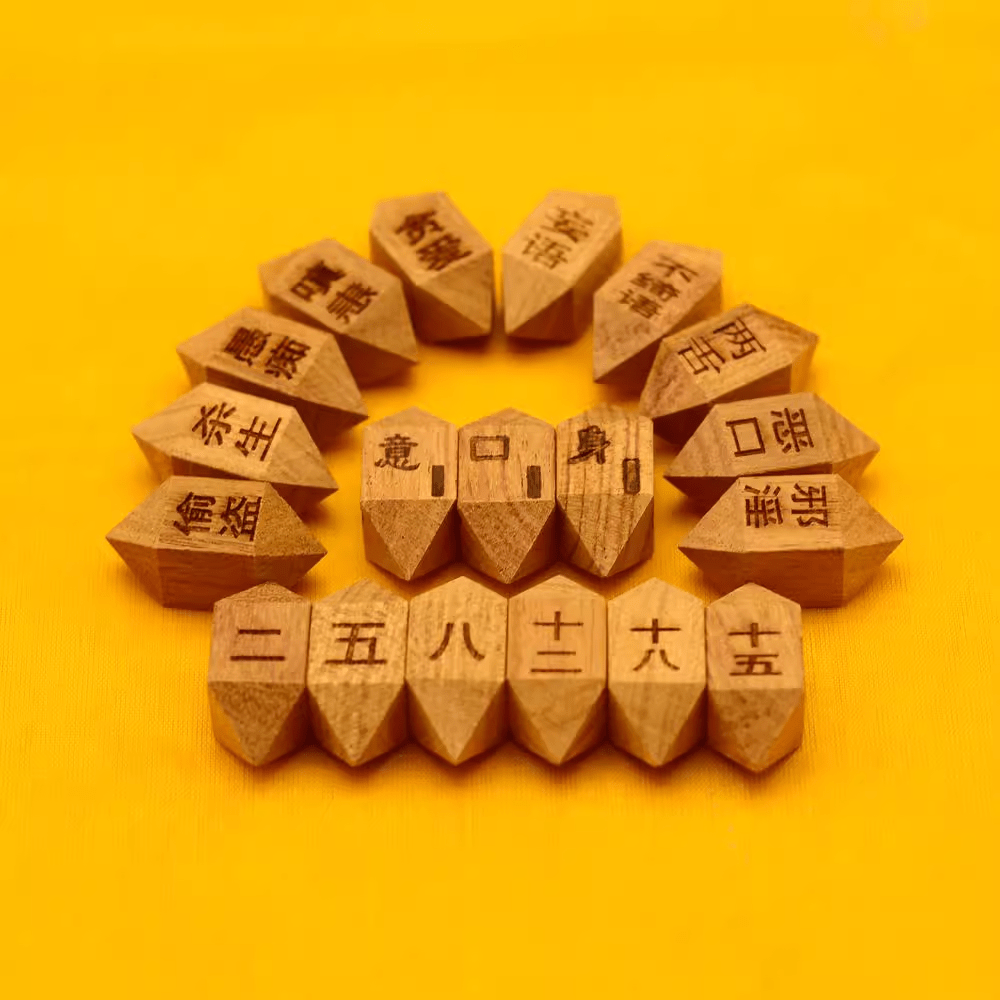
The physical wooden wheels (占察輪) described in this sutra had long been lost. It is said that the modern-era master Hongyi re-carved a set based on the sutra’s instructions. These are now easy to purchase. The wheel looks like this:
The lower fascicle has already been translated into English by Rulu. See: https://www.sutrasmantras.info/sutra12.html
Therefore, only the upper volume is translated here.
Translated by the Sindhu Tripiṭaka Master Bodhi Lamp
Thus have I heard:
At one time, the Bhagavān, the Omniscient One, was dwelling on Gṛdhrakūṭa Mountain in Rājagṛha. There, by means of his supernatural power, he manifested a vast, magnificent, pure, and unobstructed Dharma assembly ground, and was together with an immeasurable, boundless assembly, expounding the profound Dharma gate of restraining the six faculties.
At that time, in the Dharma assembly, there was a Bodhisattva named Firm Pure Faith, who rose from his seat, arranged his robe, bared his right shoulder, and joined his palms in reverence toward the Buddha. He said: “Now, in the midst of this assembly, I wish to ask a question. I earnestly beseech the World-Honored One—may you kindly listen and grant permission.”
The Buddha said: “Virtuous man! You may ask whatever you wish. Now is the time to speak.”
The Bodhisattva Firm Pure Faith said: “Just as the Buddha previously taught: ‘After my parinirvāṇa, when the True Dharma declines and the semblance Dharma is nearing its end and the age of the Final Dharma is about to begin—in such a time, sentient beings will have shallow blessings, many decline and sufferings, the nation will be in frequent turmoil, and disasters will occur repeatedly. Various sufferings and fears will oppress and distress the people. My disciples will lose their wholesome thoughts and only increase in greed, anger, jealousy, and arrogance. Even those who outwardly appear to be practicing wholesome Dharma will merely pursue worldly fame, reputation, and material gain as their main aim, and will not be able to wholeheartedly cultivate the essential Dharma for liberation from birth and death. At that time, sentient beings, seeing the worldly disasters and turmoil, will often feel timid and weak at heart, worrying and fearing that they and their family members will be unable to obtain food and clothing to sustain body and life. Due to the many obstructive causes and conditions, their faculties for the Dharma will be dull and their faith feeble. Very few will be able to attain the path. Eventually, even among the Three Vehicles of the Buddha’s Dharma, those who can give rise to firm faith will become exceedingly rare. All those who cultivate worldly meditations, arouse supernatural powers, and can know their past lives will also gradually disappear. After this, having passed through a long time in the Final Dharma Age, the attainment of the path, the arising of faith, meditative absorption, and supernatural powers—all will vanish completely.’
Now, it is for the sake of that future degenerate world, in the era when the semblance Dharma is ending and in the Final Dharma, and for those who still possess a slight amount of wholesome roots, that I now ask the Tathāgata: What method should be established to guide, educate, and instruct them so that they can give rise to faith and eliminate decline and suffering? Because these sentient beings, encountering such an evil and defiled time with many obstructions, lose their aspiration toward goodness, they repeatedly give rise to doubts regarding the causal laws of the world and of the supramundane, and cannot set their minds firmly to seek wholesome Dharma. Such sentient beings are worthy of compassion and worthy of being saved. The World-Honored One, with great loving-kindness and compassion and complete in all-knowing wisdom, I hope you will raise up a skillful method to instruct and enlighten them, so that they may be freed from the net of doubts, eliminate various obstacles, and allow their faith to grow. No matter which of the Vehicles they follow, they may swiftly attain the state of non-retrogression.”
The Buddha said to Firm Pure Faith: “Excellent! Excellent! Your question is truly good and aligns deeply with my intention. Now, in this great Dharma assembly, there is a Bodhisattva-Mahāsattva named Earth Treasury. You should pose this matter to him. He will establish a skillful Dharma gate for you, to expound and explain it, thereby fulfilling your wish.”
At that time, the Bodhisattva Firm Pure Faith again said to the Buddha: “Tathāgata, World-Honored One, you are the unsurpassed one of great wisdom! Why do you not speak yourself, but instead have that Bodhisattva Earth Treasury expound it?”
The Buddha told Firm Pure Faith: “You should not give rise to thoughts of superior or inferior distinction. This virtuous man, since the time he first generated the Bodhi mind, has passed through immeasurable, boundless, inconceivable asaṅkhyeya kalpas—a time so long that he has long since been able to cross the ocean of sarvana and has perfected all merits and virtues. Yet, in accordance with his original vows and the power of his autonomous capabilities, he manifests transformation bodies by skillful means, and his form responds throughout the ten directions. Although he universally travels and teaches in all Buddha lands, constantly arising in actions that benefit sentient beings, yet in this Five Defilements Evil World, the teaching and benefit he gives are especially deep and profound. This is also due to the karmic power of his original vow and the karmic causes of the sentient beings who ought to receive his teaching.
For the past eleven kalpas, he has been adorning this world, maturing the wholesome roots of sentient beings. Therefore, in this Dharma assembly, his form is dignified and majestic, his virtuous power exceedingly supreme—apart from the Tathāgata, none can surpass him. Moreover, concerning the teaching and guiding efforts in this world, aside from Bodhisattvas like Universal Auspiciousness (“遍吉”/Samantabhadra) and Avalokiteśvara, none of the others can compare with him. Because this Bodhisattva’s original vow-power can swiftly fulfill all of sentient beings’ wishes, can extinguish all of their heavy offenses, and remove various obstacles, enabling them to immediately manifest peace and stability—furthermore, this Bodhisattva is called ‘Skillful Comforting and Expounding One.’ That is to say, he skillfully expounds the profound Dharma of the Buddha, and is able to well instruct those who have just generated the mind to seek the Mahāyāna Dharma, enabling them not to feel timid or weak. Because of these and other such causes and conditions, in this world, sentient beings longingly look up to him, and through accepting his teaching, they are able to attain deliverance. Therefore, I now allow him to expound for you.”
At that time, the Bodhisattva-Mahāsattva Firm Pure Faith, having understood the Buddha’s intention, immediately urged the Bodhisattva-Mahāsattva Earth Treasury, saying: “Excellent indeed, true savior of the world! Excellent indeed, great master of wisdom! Just as I have asked: ‘In this degenerate world, by what skillful Dharma gate should sentient beings be taught and guided, so that they may be distanced from all manner of obstacles and give rise to firm faith?’ The Tathāgata has now entrusted this skillful Dharma gate for you to expound. You should know that the time has come—please, with a compassionate heart, explain it to us.”
At that time, the Bodhisattva-Mahāsattva Earth Treasury said to the Bodhisattva-Mahāsattva Firm Pure Faith: “Virtuous man! Listen carefully. I shall now explain it for you. If, after the passing of the Buddha, in the evil and defiled world, those bhikṣus, bhikṣunīs, upāsakas, and upāsikās are unable to give rise to decisive faith in the law of cause and effect, both worldly and supramundane; if they are unable to cultivate contemplation on impermanence, suffering, non-self, and impurity, so that these contemplations become manifest before them; if they cannot diligently observe the Dharma of the Four Noble Truths and the Twelve Links of Dependent Origination; or if they cannot diligently contemplate such principles as thusness, the ultimate reality, the unborn and the undying—then due to their failure to contemplate these Dharma teachings diligently, they will ultimately be unable to completely avoid committing the ten types of fundamental, grave unwholesome actions. They will be unable to generate single-minded and profound faith in the merits of the Three Jewels and the various Dharma realms. They will have no determined direction within the Three Vehicles of the Buddha’s Dharma.
Such people, when faced with all kinds of obstructive circumstances, will give rise to increased worry, or develop doubts, or regret. Their minds will remain unclear no matter where they are. They will be greedy, afflicted by many defilements, entangled by numerous affairs. Their conduct will lack decisiveness, their thoughts will be chaotic and disturbed, and they will neglect the practices of the Buddha-path. People who suffer from such obstacles and difficulties should employ the method of divination using the wooden wheel, in order to examine the wholesome and unwholesome karmic retributions from past lives, and to discern the suffering, joy, fortune, or misfortune they are presently undergoing. All things arise due to the coming together of causes and conditions, and cease when those conditions disperse. The manifestation of karmic force arises following one’s mind—it appears as karmic signs, and from these signs retribution arises. Karmic results are neither lost nor destroyed. Cause and effect correspond without error. In this way, by truthfully divining the retribution of wholesome and unwholesome karma, one can gain insight and guidance for one’s own mind. For matters about which one has doubts, one can thereby arrive at clear and decisive understanding. If one is a disciple of the Buddha, one should only learn this kind of method of karmic divination and, with utmost sincerity, take refuge in it. Then whatever one observes will never be inaccurate or false. One should not abandon this Dharma gate and instead follow worldly methods of divination, augury, and various fortune-telling practices, delighting in and becoming attached to cultivating them. If one delights in cultivating those, it will deeply obstruct the path to awakening.
“Virtuous man! One who wishes to learn the method of divination using the wooden wheel should first carve wood into pieces about the size of a little finger, slightly shorter than one inch in length. The middle part should have four sides and be carved smooth and even. The rest of the piece should gradually taper to points at both ends. It should be cast with the palm upward so that it spins easily. For this reason, it is called a ‘wheel.’ Moreover, this wheel form can break the net of false views and doubts of sentient beings, guiding them toward the right path and leading them to a place of peace and stability. Therefore, it is called a ‘wheel.’ This wheel method has three sets. What are the three? The first set is that the wheel form can reveal the differences in wholesome and unwholesome karmic seeds created in past lives—this set includes ten wheels. The second set is that the wheel form can reveal the differences in the duration of accumulated karmic force from past lives, and the strength or weakness, magnitude or smallness, of the karmic actions—this set includes three wheels. The third set is that the wheel form can reveal the distinctions in retributions received across the three times—past, present, and future—this set includes six wheels.
“If one wishes to observe the distinctions in wholesome and unwholesome karma created in past lives, one should carve wood to make ten wheels. Among these ten wheels, write upon them the names of the ten wholesome actions. One wholesome action corresponds to one wheel and is written on one of its surfaces. Then, match each of the ten unwholesome actions with the ten wholesome ones, writing them on the opposite surfaces, so that each is recorded separately on its own side. What is referred to as the ten wholesome actions is the root of all wholesome Dharma, able to encompass all other wholesome actions. What is referred to as the ten unwholesome actions is the root of all unwholesome Dharma, able to encompass all other unwholesome actions.”
“If one wishes to perform divination using this type of wheel, one must first learn to, with utmost sincerity, universally pay reverent homage to all Buddhas of the ten directions. Upon doing so, one should immediately generate this vow: ‘May all sentient beings in the ten directions swiftly attain the opportunity to approach and make offerings to the Buddhas, to inquire and receive the true Dharma.’ Next, one should learn to, with utmost sincerity, respectfully pay homage to all Dharma Treasuries of the ten directions. Upon doing so, one should immediately generate this vow: ‘May all sentient beings in the ten directions swiftly be able to uphold, recite, and practice the Buddha Dharma according to its principles, and expound it for the benefit of others.’ Following that, one should learn to, with utmost sincerity, respectfully pay homage to all noble sages in the ten directions. Upon doing so, one should immediately generate this vow: ‘May all sentient beings in the ten directions swiftly attain the opportunity to approach and make offerings to the noble ones, to give rise to the Bodhi mind, and to generate the vow of never retrogressing.’ Lastly, one should learn to, with utmost sincerity, pay homage to me, the Bodhisattva-Mahāsattva Earth Treasury. Upon doing so, one should immediately generate this vow: ‘May all sentient beings in the ten directions swiftly eliminate evil karma and heavy offenses, be distanced from all forms of obstacles, and attain complete sufficiency in all their necessities for livelihood.’ After completing these acts of reverent homage, one should then proceed to offer such items as incense, flowers, and other offerings as one has available.
“When making offerings, one should recollect the Buddha, Dharma, and Saṅgha—the Three Jewels—and remember that their essential nature is eternally pervasive and fills all things, present everywhere without obstruction. May these incense and flowers be identical to the Dharma nature, universally permeating and suffusing all Buddha-lands, performing the Buddha’s works. One should also recollect that all the offering vessels in the ten directions never cease to exist at any moment. ‘I now should, in my mind, envision and simulate the entire variety of incense, flowers, jeweled necklaces, banners, canopies, jeweled parasols, all kinds of rare and exquisite ornaments, various types of music, lamps, candlelight, food and drink, clothing, bedding, medicinal decoctions—and even all manner of magnificent offering vessels throughout the ten directions—and, together with all sentient beings, offer them in homage’. One should recollect that in all worlds there are those currently cultivating offerings, think ‘I now rejoice in their merit. If there are those who have not yet cultivated offerings, may they receive guidance and be inspired to begin such practice. Furthermore, may my body swiftly reach all Buddha-lands and, in the presence of all Buddha, Dharma, and Saṅgha of the Three Jewels, equally uphold and offer, together with all sentient beings, every kind of magnificent offering vessel to the Dharma-body, the form-body, the relics, images, stupas, temples, and all Buddha activities; to all Dharma Treasuries and places of Dharma teaching; and to all noble Saṅgha assemblies. May I, along with all sentient beings, through cultivating such offerings, gradually achieve the Six Pāramitās and the Four Immeasurables, and deeply realize that all Dharmas are originally serene and pure, unborn and undying, uniformly equal in one flavor, free from deluded thoughts and purified—ultimately perfect and complete.’
“In addition, one should especially focus the mind and wholeheartedly offer to me, the Bodhisattva-Mahāsattva Earth Treasury. Then one should recite my name or silently recall and contemplate it. With a single mind, one should earnestly supplicate, saying: ‘Namo Bodhisattva-Mahāsattva Earth Treasury.’ In this manner, the recitation of the name should be completed one thousand times. After completing the one thousand recitations, one should then say: ‘Bodhisattva-Mahāsattva Earth Treasury, great compassion and loving-kindness! I earnestly pray that you protect and remember me and all sentient beings, swiftly eliminate all kinds of obstacles, and increase pure faith, so that what I now seek to observe may correspond to reality.’ After saying these words, one should then take the wooden wheel in hand and, upon a clean surface, cast it out from the side. In this manner, whether one wishes to observe one’s own karmic retribution or that of others, one should proceed accordingly.”
“One should understand that when performing divination with the wheels, whatever karmic signs are revealed must be carefully observed, contemplated, and verified one by one. The result may indicate purely and fully completed ten wholesome actions, or purely and fully completed ten unwholesome actions; or a mixture of wholesome and unwholesome actions; or purely wholesome actions but not completely fulfilled; or purely unwholesome actions but not completely fulfilled. In this way, since the types of karmic causes differ, the resulting habits and retributions also vary accordingly, just as the Buddha, the World-Honored One, has extensively explained in other teachings. One should recall, reflect upon, and examine whether the revealed karmic seeds correspond to the experiences of pleasure and suffering, fortune and misfortune in the present life, as well as the afflictions, karmic forces, and habitual tendencies—if they are fairly well aligned, this is called ‘correspondence’; if they are not aligned, this indicates a lack of utmost sincerity, and is called ‘false and erroneous.’
“If during the wheel divination, neither wholesome nor unwholesome karma is revealed, this indicates that the person has already realized the wisdom mind free from outflows, is focused solely on liberation from birth and death, and no longer delights in receiving worldly karmic retributions. The various karmic forces with outflows have consequently become weak through transformation and no longer grow, and so they do not appear. Additionally, for those who are not purely wholesome, or not purely unwholesome, any karmic seeds that do not appear are because those karmic forces are too weak to bring about retribution, and thus do not manifest.
“If, in the future, disciples of the Buddha have already performed karmic divination and received corresponding results, then when they enjoy the five sensual pleasures and various necessities of life and experience what pleases their hearts and minds, they must not indulge themselves and give rise to a mind of negligence. They should instead reflect: ‘It is due to my having performed such wholesome actions in previous lives that I now receive this retribution. Now is precisely the time to turn and diligently cultivate further; I must not cease.’ If they encounter various disasters, various declines, sufferings, misfortunes, disturbances, anxieties, fears, or feel dissatisfaction and hardship, they should willingly endure it and not give rise to doubt, regret, or lose the intention to cultivate wholesome actions. They should reflect: ‘This is only because I performed such unwholesome actions in past lives that I now receive this retribution. I should now repent of those unwholesome actions and wholeheartedly practice the antidotal methods and cultivate other wholesome Dharma. I must not stop here, become negligent and lax, thereby increasing and accumulating all manner of suffering.’ This is called the method of observing the first set of wheel symbols.””
“Virtuous man! If one wishes to divine the length of time over which past karma has been accumulated, as well as the strength and magnitude of the karmic actions performed, one should further carve wood into three additional wheels, corresponding respectively to body, speech, and mind—each assigned to one wheel—and mark them with writing. At the center of each wheel, on the first face, draw a thick and long line extending to the edge of the wheel. On the second face, draw a thin and short line that does not reach the edge. On the third face, carve a thick and deep notch along the side. On the fourth face, carve a thin and shallow notch along the side. You should understand that the adornments brought about by wholesome karma are like decorations, while the harm brought about by unwholesome karma is like damage. The line that is long and thick indicates that wholesome karma has been accumulated for a long time, and the actions performed were vigorous and forceful, producing powerful and increasing karmic strength. The line that is thin and short indicates that the wholesome karma has been accumulated only recently, that one has only just begun to practice, that one’s faculties are dull, and that the resulting karmic force is weak. The notch that is thick and deep indicates that unwholesome karma has been cultivated for a long time, and that the actions performed generated strong and increasing karmic force, leaving behind deep and serious afflictions. The notch that is thin and shallow indicates that the decline of wholesome karma occurred more recently, and that unwholesome Dharma has only just begun to be practiced, such that the resulting karmic force has not yet become strong. Or, although one may have committed severe unwholesome deeds, one has already repented and corrected them—this is called minor evil.
“Virtuous man! If one observes only the first set of wheels, one can know the distinction between wholesome and unwholesome karma created in past lives, but cannot know the duration of the accumulated karma, nor the strength or magnitude of the karmic force. Therefore, one must observe the second set of wheels. When observing the second set, one should base it on the result shown in the first set. If it pertains to karma of the body, then cast the body wheel; if it pertains to karma of speech, then cast the speech wheel; if it pertains to karma of mind, then cast the mind wheel. These three wheels must not be cast simultaneously for a single reading. One must cast them individually, depending on the principal karma one wishes to observe—each specific wholesome or unwholesome karma should be cast using its corresponding wheel.
“Furthermore, if in the first wheel reading one receives a result showing bodily wholesome karma, but in the second wheel reading one receives bodily unwholesome karma, this indicates a lack of utmost sincerity and a result that is not in accord, and is thus called false and erroneous. Another case of discrepancy would be this: in the first wheel reading, one receives the karma of not killing and also the karma of stealing; but if one is mentally focused on observing the karma of not killing, and the second wheel yields a result of major bodily unwholesome karma, this is considered non-correspondent.
“Additionally, if one observes that since birth one has not liked killing and has never committed the sin of killing, but one’s mind is focused on killing, and the second wheel yields a result of major bodily unwholesome karma, this is also called non-correspondent. Other instances of non-correspondence within the karmas of speech and mind follow the same reasoning and should be understood accordingly.
“Virtuous man! If, in future times, there are sentient beings who wish to pursue liberation from birth, aging, sickness, and death, and have just begun to develop the mind to cultivate meditative concentration and formless wisdom, they should first observe how much unwholesome karma they have accumulated in past lives and the severity of that karma. If their unwholesome karma is abundant and heavy, they should not immediately proceed to cultivate concentration and wisdom. They must first practice the Dharma gate of repentance. Why is this? Because the evil mind they cultivated in past lives was fierce and intense, and in the present life they will certainly commit many unwholesome acts and violate grave precepts. Due to these serious precept violations, if they do not repent and purify their karmic obstructions and instead directly proceed to cultivate meditative concentration and wisdom, they will encounter many hindrances and will not be able to achieve accomplishment within the expected time. They may fall into states of mental confusion, be disturbed or harmed by heretical paths or demonic forces, or may accept deviant teachings and increase their wrong views. Therefore, they must first practice the Dharma of repentance. If the foundation of their discipline becomes pure and the heavy karmic offenses from past lives become weakened, then they will be able to distance themselves from all such obstacles.
“Virtuous man! One who wishes to cultivate the practice of repentance should reside in a quiet place and, according to their capabilities, solemnly arrange a room. Within this room, they should prepare a setting for Buddha activities and place Buddhist scriptures, hang colorful banners and canopies, and gather incense and flowers to be used in the practice of offering. They should bathe and cleanse their body and wash their clothes, ensuring that neither the body nor garments carry any foul impurity. During the daytime, within this room, one should recite the Buddha’s name at three intervals. With single-minded reverence, they should pay homage to the Seven Buddhas of the past and the Fifty-three Buddhas. Then, following the ten directions, they should generally and collectively direct their mind toward reverent worship, mentally visualizing universal homage to all Buddhas’ form-bodies, relics, images, stupas, temples, and all Buddha activities. After that, they should offer universal homage to all Buddhas of the ten directions and three times, then mentally visualize offering homage to all Dharma Treasuries in the ten directions, and then mentally visualize offering homage to all noble Saṅgha in the ten directions. Afterward, they should especially recite the name and pay homage to me, the Bodhisattva-Mahāsattva Earth Treasury.
“After completing these acts of worship, one should confess the transgressions they have committed, and with a sincere heart, make this declaration:‘May all the World-Honored Ones of the ten directions, who are greatly compassionate, bear witness and protect me. I now repent and vow never to commit such acts again. May I and all sentient beings swiftly eradicate all the ten unwholesome deeds, the four grave transgressions, the five heinous offenses, perverted wrong views, slanders against the Three Jewels, and even the offenses of being an icchantika, which we have committed throughout immeasurable kalpas.’
“Next, one should contemplate: ‘The nature of these offenses arises only from a deluded and inverted mind, and there is nothing fixed or real that can be grasped. Their nature is fundamentally empty and tranquil. May I and all sentient beings swiftly realize the origin of mind and forever eliminate the root of all offenses.’
“Then, one should generate the vow of invitation and entreaty: ‘May all the Bodhisattvas of the ten directions who have not yet attained Perfect Enlightenment swiftly realize the Right Awakening. And may those who have already attained enlightenment remain in the world, turn the wheel of true Dharma, and not enter parinirvāṇa.’
“Then one should generate the vow of rejoicing: ‘May I and all sentient beings forever abandon the mind of jealousy and, in all Buddha lands throughout the three times, sincerely rejoice and praise all those who are cultivating and have already accomplished all virtues.’
“Then one should generate the vow of dedication: ‘May all the merits and virtues that I have cultivated benefit and support all sentient beings, so that together we may aspire toward the wisdom of the Buddhas and reach the city of Nirvāṇa.’ “After making this vow of dedication, one should then go to another quiet room, sit upright with focused posture, and single-mindedly concentrate—either by reciting aloud or silently recalling my name. One should reduce sleep, and if one struggles with torpor or restlessness, they should walk and chant within the practice hall.
“At night, if conditions permit lighting lamps and obtaining brightness, one should likewise, in three sessions, respectfully make offerings, repent offenses, and declare vows. If one cannot arrange for lighting, then they should remain in another quiet room and single-mindedly recite. Each day, one should practice the repentance in this manner without becoming lax or negligent. If someone has deep wholesome roots from past lives but only temporarily encountered adverse conditions and committed unwholesome deeds, and their karmic obstructions are relatively light, and they possess courageous diligence and strong resolve—then within seven days they will attain purity and remove all obstacles. Among such sentient beings, the weight of their karmic obstructions and the sharpness or dullness of their faculties differ in limitless and boundless ways. Some attain purity after two sets of seven days; some after three sets; and some after seven sets of seven days. If one has committed extremely grave offenses in both past and present lives, some may attain purity after one hundred days; some after two hundred days; and some even after one thousand days. If someone’s faculties are especially dull and their karmic offenses the heaviest, yet they can give rise to a fierce resolve, cherishing neither body nor life, constantly reciting my name with diligence, walking day and night, reducing sleep, paying homage, repenting, making vows, joyfully cultivating offerings without sloth or neglect—even to the point of death they do not stop or retreat—then by practicing with such diligence, they will certainly attain purity within one thousand days.
“Virtuous man! If one wishes to know whether one has obtained the mark of purity, then starting from the beginning of practice, after seven days, one should, every day at dawn in the early morning, securely place the second set of wheels in one’s hands and cast them three times in succession. If the body, speech, and mind are entirely of wholesome signs, this is called having attained purity. In this way, in future worlds, those beings who are able to practice the repentance method have all, from a long time ago, in the Buddha’s teachings, each cultivated wholesome dharmas. According to the kind of merit they have cultivated, the karmic obstructions differ—some heavier, some lighter—with various distinct differences. Therefore, when they obtain purity, the auspicious signs that manifest also differ. Some beings, upon attaining the wholly wholesome signs of the three karmas, do not immediately gain further auspicious signs. Some beings, upon attaining the wholesome signs of the three karmas, within a single day and night, then see light filling their entire room, or smell extraordinarily rare and fine fragrances, or feel physical and mental ease and delight, or have good dreams. In the dream they see the Buddha’s form-body coming to certify them, touching their head with his hand and praising: ‘Well done! You are now pure. I have come to certify you.’ Or they dream of a Bodhisattva-Mahāsattva personally coming to certify them, or dream of a Buddha image emitting light to certify them. If a person has not yet attained the wholesome signs of the three karmas but merely sees or hears such things beforehand, then that is false, deceptive, deluding, and unreal—it is not a wholesome sign.
“If a person has previously planted the wholesome roots of renouncing the world, and focuses the mind with courage and diligence, then I, at that time, in accordance with the occasion when they are due to be transformed, manifest a form-body for them. I emit great compassionate light to calm them and distance them from all kinds of doubts and fears. Or I display various supernatural powers and transformations. Or I cause them to recall past-life events and the good or evil karma they have created. Or I, in accord with what they delight in, expound for them various profound and essential Dharma methods. That person then immediately gains resolute faith in the vehicle they aspire toward, or gradually realizes and attains the fruit of the śramaṇa path.”
“Furthermore, even if those beings do not get to see my manifested body transforming and speaking the Dharma, as long as they learn to cultivate with utmost sincere mind, such that their body, speech, and mind attain the mark of purity, I shall also protect and bear them in mind, enabling them to swiftly eradicate all kinds of obstructions. Māra Pāpīyas will not come to destroy them, and even the ninety-five heretical paths and all demons and spirits will not come to disturb them. All of the five hindrances will gradually become light, and they will be capable of cultivating various dhyānas and wisdom.
“Furthermore, if beings in future worlds, although not seeking dhyāna, wisdom, or other essential paths of liberation from birth and death, yet encounter various adversities, poverty and hardship, sorrow and affliction pressing upon them, they too should respectfully worship, make offerings, and repent their evil karma, constantly confessing and making vows. At all times and in all places, they should earnestly and wholeheartedly recite my name, making their intention sincere. They too should swiftly be freed from all decline and suffering, and after leaving this life, be reborn in a wholesome destination.
“Furthermore, in future worlds, all beings—whether householders or those who have left the household life—if they wish to seek and receive the pure and wondrous precepts, but have previously committed extremely grave and intensified offenses that prevent them from receiving the precepts, they should, as explained above, practice the repentance method, so that, by attaining utmost sincere mind and obtaining wholesome signs in body, speech, and mind, they may then receive the precepts. If those beings wish to cultivate the Mahāyāna path, seeking to receive the fundamental grave precepts of the Bodhisattvas, and also vow to universally receive all precepts for both householders and renunciants—namely, the precept of restraint of discipline, the precept of cultivating wholesome dharmas, and the precept of transforming sentient beings—but are unable to encounter a virtuous and qualified precept master, one who thoroughly understands the Bodhisattva Dharma treasury and has already undertaken the practice beforehand, then they should, with utmost sincere mind, within a Dharma hall, reverently make offerings and respectfully appeal to the Buddhas and Bodhisattva-Mahāsattvas of the ten directions, inviting them to serve as witnessing masters. With one mind, they should establish vows, recite the names and describe the characteristics of the precepts, first stating the ten fundamental grave precepts, and then universally taking the three categories of precepts. Through self-vowing, they receive the precepts, and in this way, they are also considered to have received the precepts.
“Furthermore, in future worlds, all those beings who wish to leave the household life, as well as those who have already gone forth, if they are unable to encounter virtuous and qualified precept masters and a pure saṅgha community, and their hearts give rise to doubts, making them unable to uphold and maintain the precepts in accordance with Dharma, so long as they are able to learn to arouse the aspiration for the unsurpassed path, they too can purify their body, speech, and mind. Those who have not yet gone forth should shave their heads, put on Dharma robes, and just as stated above, establish vows and, through self-vowing, uphold and maintain the Bodhisattva prātimokṣa’s threefold collection of precepts. This is called having fully obtained the renunciant’s prātimokṣa precepts, and may be called a bhikṣu or bhikṣuṇī. At this time, they should seek to study the Śrāvaka Vinaya Treasury, as well as the Mātṛkā treasury studied by the Bodhisattvas, receive and uphold it, recite and study it, observe and cultivate accordingly.
“If, although one has already gone forth, one has not yet reached twenty years of age, then one should first vow to uphold the ten fundamental precepts, and to uphold all the specific precepts for śrāmaṇera and śrāmaṇerikā. After receiving the precepts, one is also called śrāmaṇera or śrāmaṇerikā. At that time, one should closely approach, make offerings to, and serve those who have previously gone forth, who uphold the Mahāyāna aspiration, and who have fully received the precepts. One should request them to serve as one’s guiding teacher, inquire about the precepts, cultivate the proper deportments, in accordance with the regulations of the śrāmaṇera and śrāmaṇerikā. If such people cannot be encountered, then one should only closely approach the Mātṛkā treasury cultivated by the Bodhisattvas, recite, contemplate, observe, and practice accordingly, and earnestly make offerings to Buddha, Dharma, and Saṅgha.
“If a śrāmaṇerikā has reached the age of eighteen, she should also, through self-vowing, receive and uphold the six precepts of the śikṣamāṇā as recorded in the Vinaya Treasury, and widely study all the precept collections of the bhikṣuṇī. If she reaches the age of twenty, then she may, as stated above, universally receive the threefold Bodhisattva precepts. Only then may she be called a bhikṣuṇī.
“If those beings, although studying the repentance method, do not attain utmost sincere mind, and do not obtain wholesome signs, then even if they visualize the act of receiving precepts, it is not called actually receiving the precepts.”
 Dharma Torch